
“Maiko-san Tanzaku” is a screen print with gold leaf by Takashi Murakami, published in 2024 in an edition of 100 signed impressions. It is the ideal work for understanding what makes screen printing special among the artist’s editions.
Screen print and offset, in brief
Murakami’s editions on paper are made with two techniques, both published by Kaikai Kiki and signed by the artist. Offset printing rebuilds the image from a very fine four-colour screen and enriches it with metallic finishes and high-gloss varnish: it is the technique behind his best-known editions. Screen printing proceeds one colour at a time, each with its own screen, and lays solid layers of ink on the paper.
They are two languages of the same artist. This article is about the second.
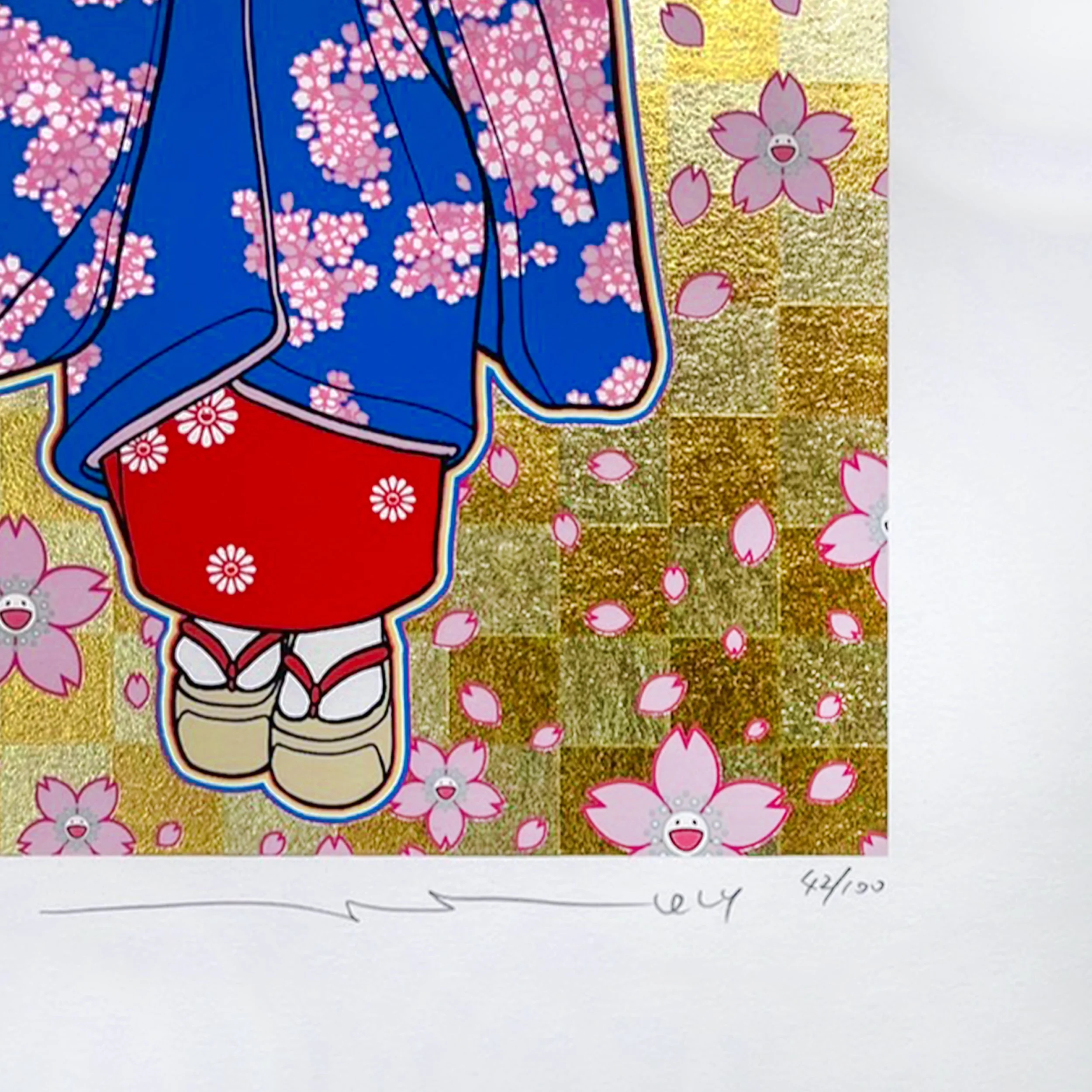
“Maiko san Tanzaku”: Signature detail
What makes a screen print special
A screen print is built in layers, and each layer leaves a trace you can see and almost feel.
Solid colour. Every hue is a continuous, opaque field with a crisp edge. Murakami’s blues, pinks and blacks carry the same density they have on canvas.
Substance. The ink has body. Tilt the sheet under raking light and you catch the slight relief between one colour and the next.
Time. Each colour needs its own screen, its own pass and its own drying time, and must fall in perfect register with the one before. An image as rich as Murakami’s needs many.
The hand of the studio. Kaikai Kiki prints part of its screen prints in a workshop inside the studio.
Maiko-san Tanzaku: gold laid by hand
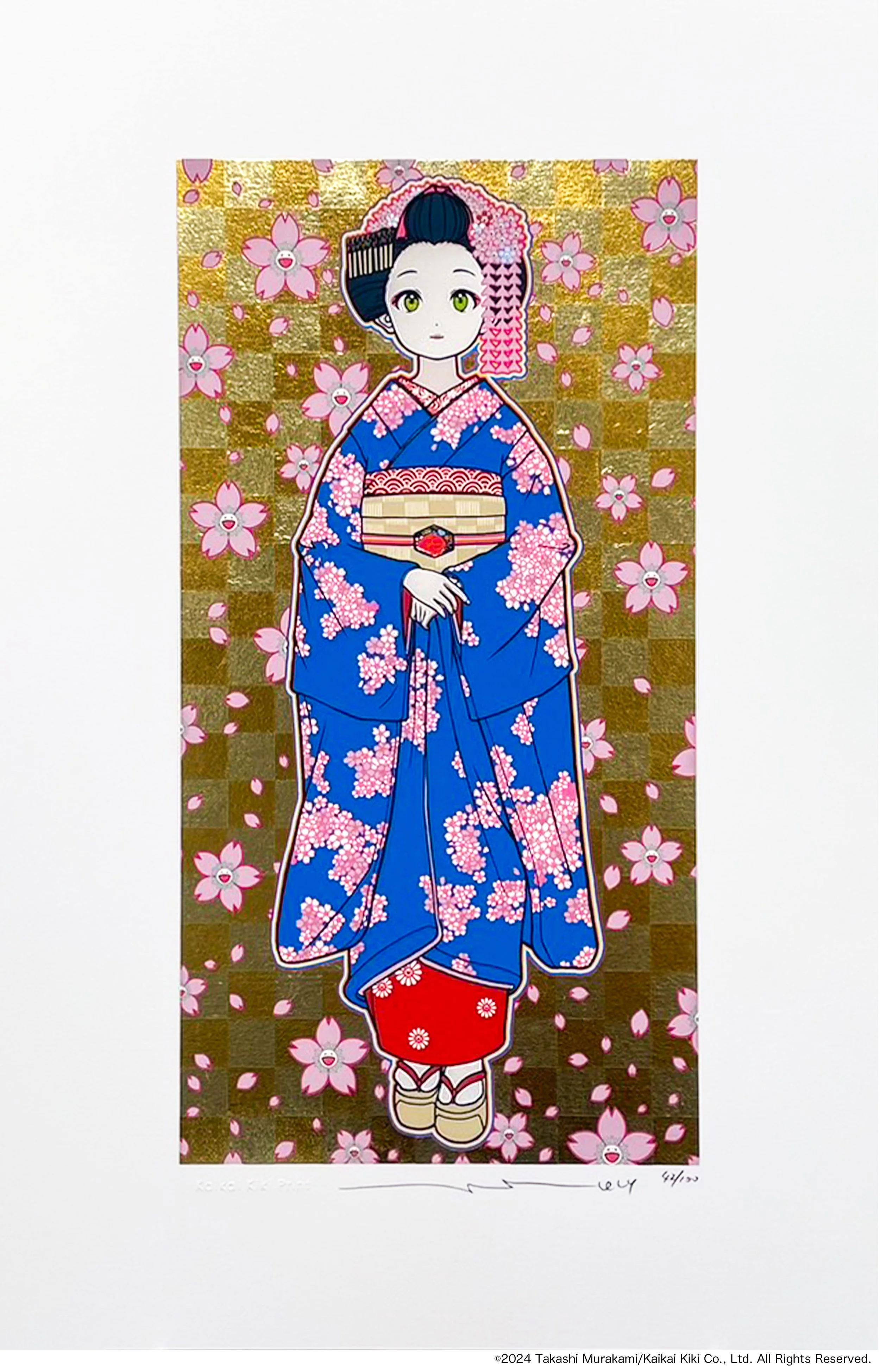
A tanzaku is the vertical strip of paper on which poems and wishes are written in Japan. Murakami borrows its tall, narrow format for a single figure: a maiko, the apprentice geisha of Kyoto, in a blue kimono patterned with pink cherry blossoms. The image measures 25.2 × 13.2 cm on a sheet of 34.2 × 21.9 cm.
The background is the heart of the work. Behind the figure runs a gold checkerboard dotted with smiling flowers, and that gold is real leaf, applied by hand. According to Kaikai Kiki, the work is carried out by in-house staff trained at art universities, using two alloys of leaf, sanbu-iro and gomō-iro: the difference in tone between the two gives the checkerboard its depth.
Every square of the checkerboard was laid by a person. That is why no two of the 100 impressions are identical: the gold has seams, reflections and tiny variations that belong to that sheet alone.
The edition is 100 plus 15 artist’s proofs, signed, numbered and dated by Murakami on the front. Part of it was first presented at the Kyoto City KYOCERA Museum of Art during the artist’s Kyoto exhibition. Gagosian links it to the London show “Japanese Art History à la Takashi Murakami” (2024–25), devoted to the artist’s dialogue with the history of Japanese art.
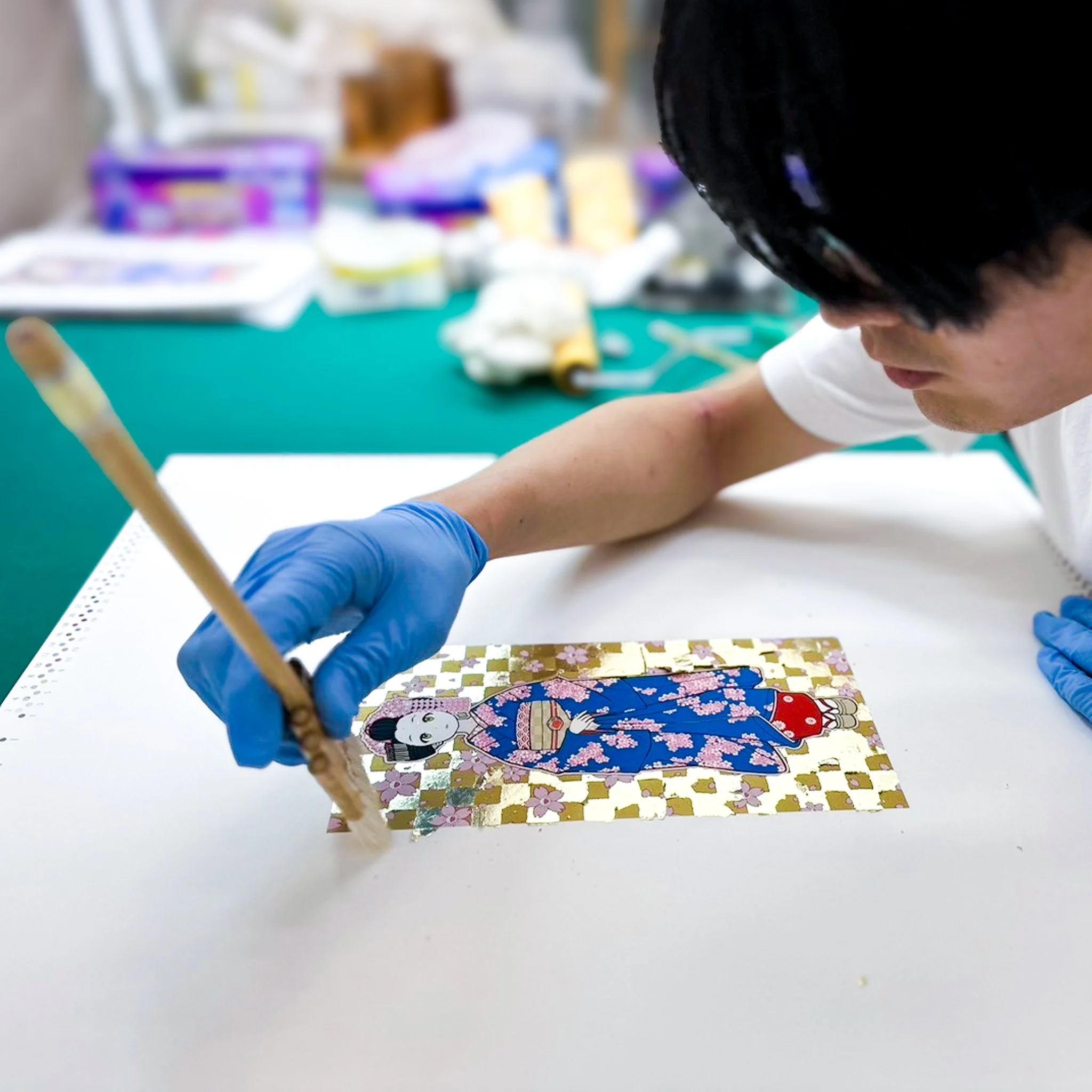
Working on “Maiko-san Tanzaku” in Kaikai Kiki Studio.
For collectors
“Maiko-san Tanzaku” brings together, in an intimate format, what collectors look for in a Murakami screen print.
Rarity. 100 impressions worldwide, for an artist with a global audience.
Presence. The gold responds to the light of the room and changes through the day. It is a work to be seen in person.
Tradition. Gold leaf, the tanzaku format and the subject tie the work to classical Japanese painting, reread in Murakami’s own hand.
Care. Gold leaf should never be touched or rubbed. Frame it with a spacer, so the glazing does not rest on the surface, and use UV-filtering glass.
“Maiko-san Tanzaku” is available at Miura Gallery.
