
A fake Murakami print does not survive comparison. That is the whole method: because Kaikai Kiki publishes official photographs of every edition and prints each copy by the same mechanical process, any print that differs from the reference in colour, detail, packaging or price is not a variant, it is a fake. This guide walks through the six checks we use at Miura Gallery before we buy a print, then the finer points a dealer looks at, where fakes tend to appear and what to do when you are not sure. No expertise is required, only a good photo and ten minutes.
Why Murakami prints are easy to fake and easy to check
Takashi Murakami’s studio, Kaikai Kiki, releases prints in regular drops through its Tokyo shops and online lottery, usually in editions of 300 for offset lithographs and 100 for silkscreens. Each edition sells out in minutes and trades at a multiple of its issue price within weeks. That combination, a famous image, a mechanical print process and a secondary market in constant demand, is exactly what counterfeiters look for, and Murakami prints are among the most copied editions in contemporary art.
The same facts work in the buyer’s favour. Because the prints are produced industrially, every genuine copy of an edition is identical: same CMYK plates, same foil, same varnish, same sheet. Because Kaikai Kiki documents each release with official photographs and specifications, there is always a reference to compare against. And because the studio ships every print in its own box with its own label and tape, the packaging is as much a part of the print as the signature. A fake has to get all of that right at once, and in our experience none does.
The six checks
Check 1: Start from the official benchmark
Every print Kaikai Kiki releases is photographed and listed on the studio’s own site with title, year, size and technique. Before you look at a listing, find the edition there and keep the official image open next to it. Everything that follows is a comparison against that reference, not a judgement from memory. If you cannot find the edition on the official site, treat the listing as unverified until you can. Your benchmark is the official Kaikai Kiki site.
Check 2: Compare colour and detail
Murakami prints are offset or silkscreen editions printed from fixed plates, so every copy of an edition is identical to the pixel. Compare the listing photos with the official image at the smallest details: the eyes of the flowers, the outline weight, the position of the signature column and seal, the exact shade of a background. A print whose colours lean warmer, whose outlines are thicker or whose skull pattern is blurred is not a colour variant or a different printing, it is a fake. Counterfeits are made from downloaded images and show the softness and colour drift that comes from re-photographing and re-printing.
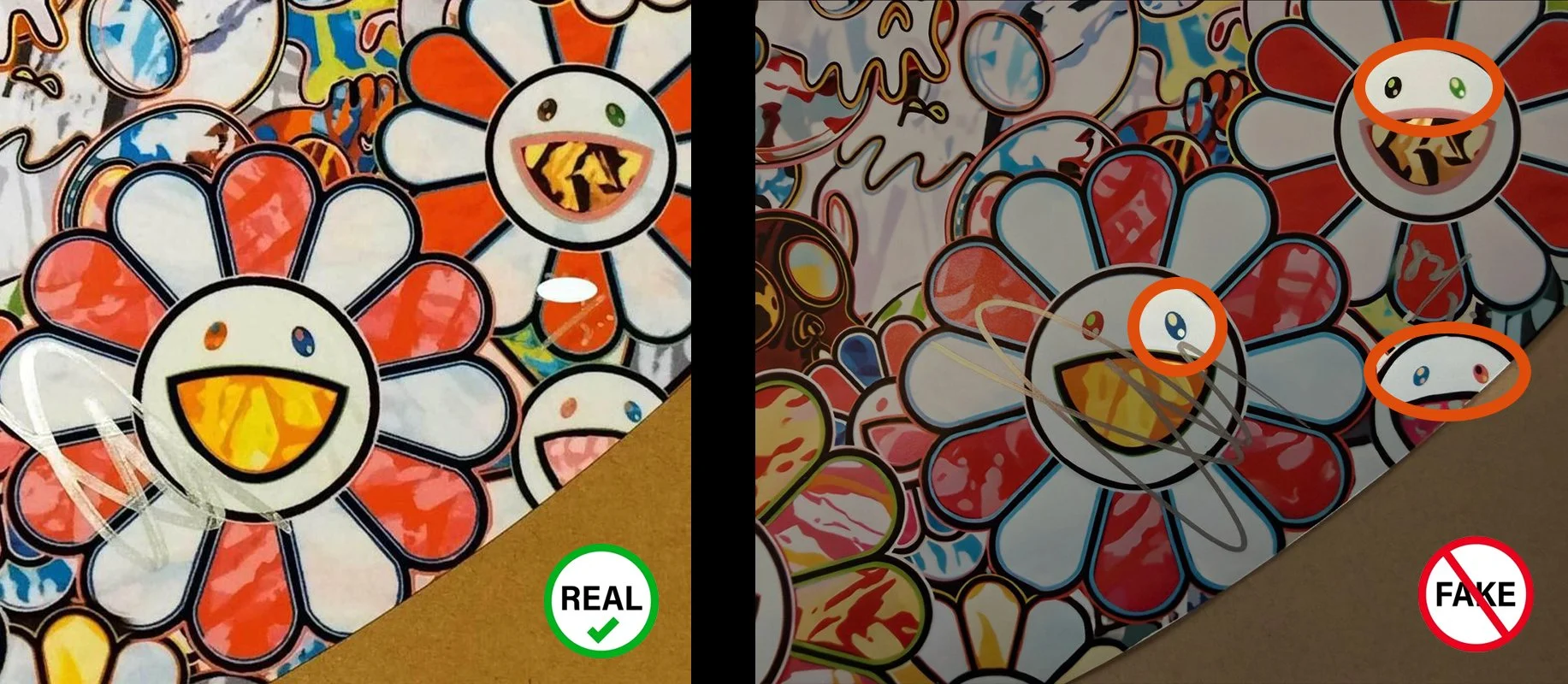
“Original” VS “Fake” - Colors comparison. Original on the left side.
Check 3: Look at the box
Kaikai Kiki ships each print in a dedicated cardboard box with a printed label: a thumbnail of the work, the title, the edition size and the copy number. Genuine labels use the studio’s own typography, with light weights and consistent margins. On fakes the label is the weak spot: the type is bolder, the margins are uneven, the thumbnail is cropped differently or printed on the wrong paper. Ask for a photo of the box and the label whenever a seller does not show them.
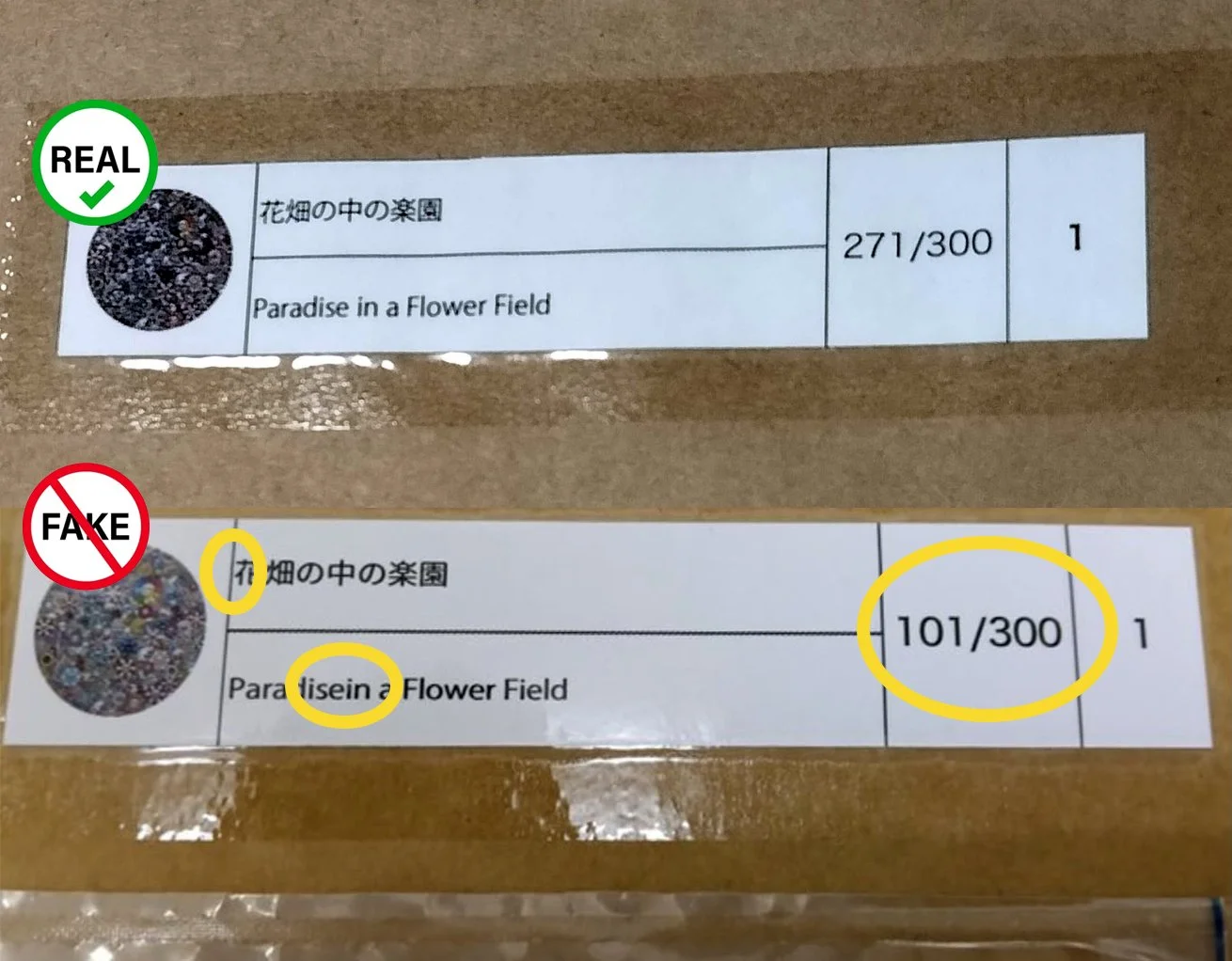
“Original” VS “Fake” - Box label comparison. Original on the top.
Check 4: Check the tape
The studio seals its boxes with a distinctive tape: rough and textured to the touch, with a dotted pattern. It is not glossy and it is not smooth. Counterfeit boxes are usually closed with ordinary clear packing tape or with a smooth printed tape that imitates the look but not the surface. It is a small detail, which is exactly why fakers ignore it.
Check 5: Read the price
Fakes are priced just above retail, high enough to look credible and low enough to tempt. Genuine prints follow the secondary market, which for most editions sits well above issue price and rises with time. A Flowers or Flower Ball print offered at a fraction of recent auction and dealer prices is not a bargain from a seller who does not know what they have; it is the price point at which fakes sell. Check completed sales on auction sites and prices at established dealers before you decide what a listing is worth.
Check 6: Understand the paperwork
Kaikai Kiki does not issue certificates of authenticity for its print editions. A “studio COA” offered with a Murakami print is therefore itself a warning sign. Purchase receipts from the Zingaro shops carry no data that ties them to a specific copy and prove nothing on their own. The authentication of a Murakami print is the print: the hand signature, the hand-written number, the publisher’s marks, the paper and finish, the box and the tape. A certificate from a dealer is a guarantee from that dealer, backed by their reputation and their obligation to take the work back, and it is worth exactly as much as the dealer.
What a dealer checks on top
The six checks above catch almost every fake from photographs. When the print is in front of us, we add four more.
Signature and number. Murakami signs each sheet by hand, in silver or black marker or in pencil depending on the edition, and writes the number as a fraction (for example 124/300). The signature is fluid and slightly different on every copy; a signature that is printed, traced or identical to the one in the official photo has been copied.
Paper and weight. Editions are printed on heavy, smooth stock with a consistent feel. Thin, bright-white or glossy photo paper is wrong. On square and round editions the sheet is cut to the published size; measure it.
Foil and varnish. Most editions carry cold foil, glitter or a gloss varnish that sits above the surface. Tilt the sheet in raking light: on a genuine print the foil pattern is crisp and the varnish follows the printed shapes exactly. Fakes either omit the finish or imitate it with a flat metallic ink that does not catch the light. We describe these finishes in detail in our guide to the Korin prints.
The back and the margins. The reverse is plain and clean, with no printed text; the margins are even and show the publisher’s copyright line where the edition has one. Trimmed margins, a copyright line in the wrong typeface or any text on the back mean the print was not made by Kaikai Kiki.
Where fakes turn up
Fakes concentrate where buyers cannot handle the print and where volume hides them: general auction platforms, marketplace apps, social media sellers and some physical galleries that stock a few Murakami editions alongside unrelated work. The listing pattern is consistent. The photos are either the official studio image reused as if it were the seller’s own, or soft, cropped phone pictures that avoid the signature, the box and the edges. The price sits a little above retail. The seller has many copies of the most popular images, Flowers, Flower Ball, the Louis Vuitton-era works, and none of the harder editions. Any one of these is a reason to ask questions; all of them together is a reason to walk away.
If you are not sure
Ask for three photographs: the full sheet in daylight, the signature and number close up, and the box with its label and tape. A seller with a genuine print has no reason to refuse. Compare them with the official image and with copies sold by established dealers. If anything differs, do not buy, however convincing the story.
Frequently asked questions
Do Murakami prints come with a certificate of authenticity? No. Kaikai Kiki does not issue certificates for its print editions. A certificate offered as coming from the studio is a warning sign; a certificate from a dealer is that dealer’s own guarantee.
How can I tell if a Murakami print is real from photos? Compare it with the official image on zingarokk.com. Genuine copies are identical in colour and detail; any difference means a fake. Then check the box label, the textured tape and the price against the market.
Are Murakami prints signed? Yes. Every limited edition is hand-signed and hand-numbered by Murakami. Unsigned copies are posters, not editions.
What size are the editions? Usually 300 for offset lithographs and 100 for silkscreens, numbered as a fraction, with a small number of AP, HC and PP proofs.
Is a print without its box fake? Not necessarily, but it is harder to verify and worth less. We do not buy prints without the original box.
