
The Korin prints are Takashi Murakami’s longest-running tribute to a single artist: a series of round offset editions, begun in 2010 and still growing, that borrow the flowers, water patterns and gold of Ogata Kōrin, the Edo-period master of the Rinpa school. They are the quiet, classical side of Murakami, and for many collectors the most beautiful editions he has published. This guide explains who Kōrin was, how the series works, which editions exist and how the prints are made, written by a dealer who sources them in Japan and sells them worldwide.
Who was Ogata Kōrin
Ogata Kōrin (1658–1716) was a painter and designer from Kyoto, born into a family of wealthy textile merchants who dressed the imperial court. He trained in the official Kano style but made his name with something freer: large folding screens of irises, plum trees and chrysanthemums laid on gold leaf, with the flowers drawn as flat, stylised shapes and the water as rhythmic lines of blue and gold. His best-known works, the Irises screens at the Nezu Museum and Red and White Plum Blossoms at the MOA Museum, are national treasures.
Kōrin gave his name to the Rinpa school (“school of Kōrin”), a lineage that had begun a century earlier with Hon’ami Kōetsu and Tawaraya Sōtatsu and that Kōrin pulled together into a recognisable style: decorative, flat, bold in colour, indifferent to Western perspective, and happy to move between painting, lacquer, ceramics and kimono design. The Rinpa habit of treating fine art and decoration as one activity is the direct ancestor of Murakami’s Superflat.
Murakami has said as much. His doctorate at Tokyo University of the Arts was in Nihonga, the tradition that descends from these painters, and his 2000 Superflat manifesto traces a line from Edo-period eccentrics through Rinpa to anime. The Korin prints are where that argument becomes visible: Kōrin’s chrysanthemums and hollyhocks, the swirling water from his screens and the tarashikomi pooling of ink are redrawn in Murakami’s cell-shaded outline style and placed on black, gold or silver backgrounds. The result reads as both a seventeenth-century screen and a twenty-first-century print.
The Korin prints: how the series works
Every Korin print shares the same anatomy, which is what makes the series so recognisable on a wall and so easy to check as a buyer.
A round sheet. Korin prints are tondos, 71 cm in diameter, printed on a circular sheet rather than a square one with a circle inside. The format comes from Rinpa fan paintings and round poem cards, and it means the works are almost always sold and framed in a circular mount.
A cluster of flowers. Chrysanthemums, hollyhocks, peonies and plum, each one drawn with a dark outline and a flat fill, stacked into a bouquet that rises from the lower edge. The flowers are Kōrin’s but the drawing is Murakami’s: the petals are counted and symmetrical, the leaves are shaded like animation cels, and the colours are deliberately off, with violet, teal and pink where Kōrin would have used mineral green and white.
Water. Across the middle of many prints runs a band of stylised water, swirling lines in gold on blue, gold on red or gold on black. This is the ryūsui motif from Kōrin’s screens, best known from his Irises and Plum Blossoms, and it is what gives the prints their names: Azure River, Red Stream, The Golden River, Stellar River in the Heavens.
A dark or metallic ground. Most editions sit on black, which sets off the foil; others are on gold, silver, white or deep red. The ground, more than the flowers, is what separates one edition from another in the series.
Signature and seals. Murakami signs each print in the lower margin and numbers it. Many Korin editions also carry a printed red seal and a column of brushed calligraphy inside the image, in the manner of a Rinpa painting, and some carry the honorific Hokkyō (“bridge of the law”), the Buddhist rank Kōrin held, in the title or the seal.
Two families inside the series. The flower-and-water prints carry the name Kōrin; a parallel group called Kansei (“quiet” or “tranquillity”) takes only the water pattern and lets it fill the whole circle, in gold, red, white or silver. The two groups were released together from 2010 onwards and are usually collected together.
Notable Korin editions
All editions below are 71 cm in diameter, edition of 300, signed and numbered, published by Kaikai Kiki. Issue prices are the Zingaro retail price in yen at release, and show how the series has moved rather than what a print costs today; titles with a link are editions currently available at Miura Gallery. Release data from the Sugimoto68 Murakami archive .
With Reverence, I Lay Myself Before You – Korin – Chrysanthemum (August 2010). Black ground, offset with cold foil and high-gloss varnish. Issue price ¥27,850. The first Korin print, released from Hidari Zingaro.
I Recall the Time When My Feet Lifted Off the Ground, Ever So Slightly – Korin – Chrysanthemum (September 2010). Black ground, same technique. The second of the 2010 pair and the scarcest Korin on the secondary market.
Kansei Korin Gold / Kansei: Korin Red Stream (2010). The water pattern alone on gold and on red, released alongside the chrysanthemum prints.
Kōrin: Pure White, The Time of Celebration, Dark Matter, Stellar River in the Heavens, Azure River, Superstring Theory (January 2016). Six editions on white, red, black, black with gold, blue and black grounds, offset with cold foil and spot varnish, released for the 500 Arhats exhibition at the Mori Art Museum. Azure River was issued at ¥42,000.
Korin: Flowers / Korin Flowers of Resurrection (September 2016). Black and gold grounds, offset with cold foil.
Kōrin: Kyoto, Courtly Elegance, The Golden Age (November 2020). Black with a blue river, gold and silver grounds, offset with cold foil and gloss varnish, sold by lottery from Tonari no Zingaro.
Kōrin: Tranquility (November 2020). Silver and black ground, offset with cold foil and gloss varnish. Available at Miura Gallery.

Kōrin: The Golden River (November 2022). Gold ground, offset with cold foil and high-gloss varnish. Issue price ¥59,800, sold by lottery from Tonari no Zingaro. Available at Miura Gallery.

Kōrin: The Land Beyond Death, Bathed in Light (November 2022). Silver ground, offset with cold foil and high-gloss varnish. Available at Miura Gallery.

Flowers Blooming in the Isle of the Dead / A Return from Wandering (November 2022). Black grounds with red and with purple flowers, the darkest prints in the series. Available at Miura Gallery.
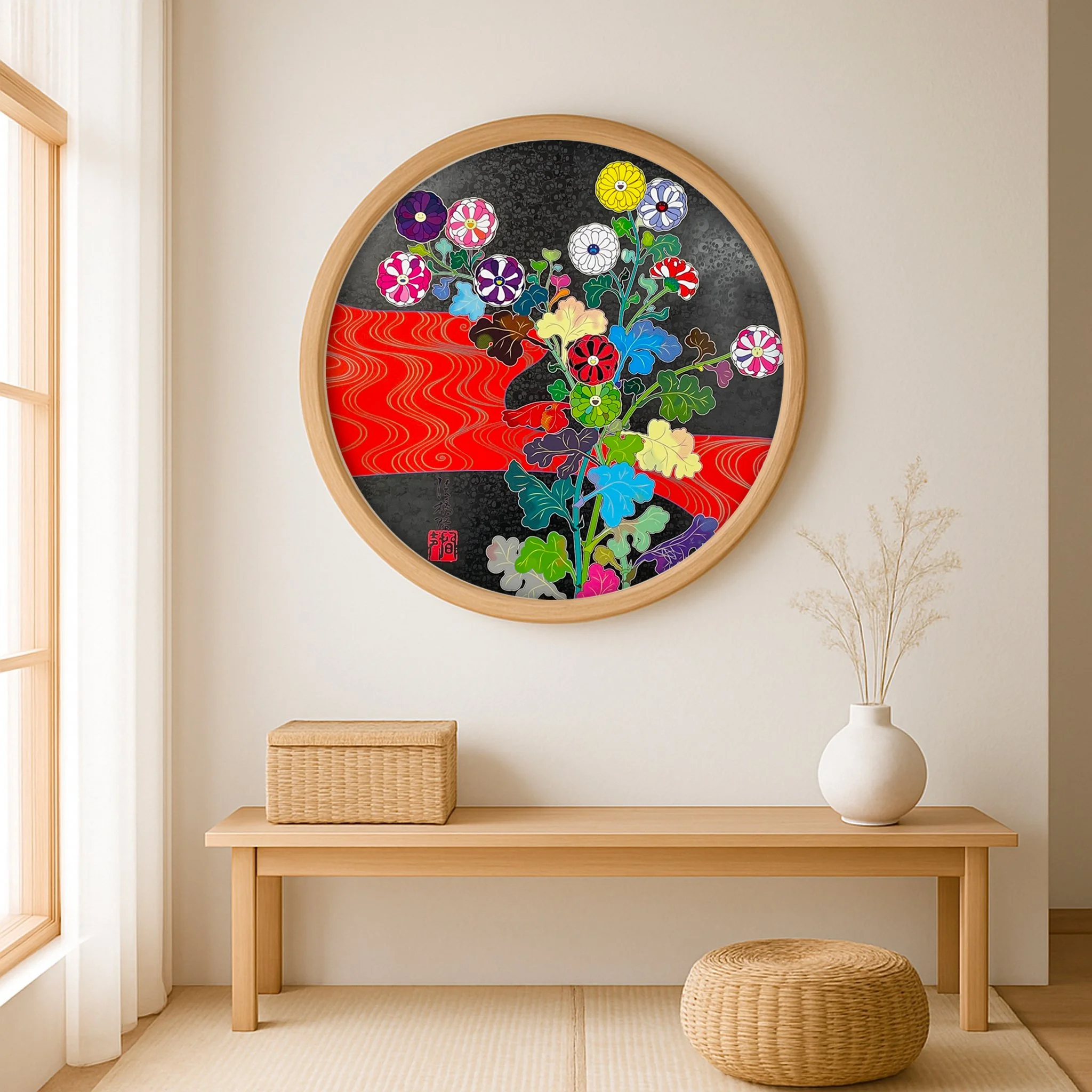
Kyoto Kōrin Mononoke Flower (November 2024). Black ground, offset with cold foil and gloss varnish; the most recent Korin release. Available at Miura Gallery.

Kōrin’s Flowers and Abstract Imagery (November 2024). Black ground with Kōrin’s flowers set against an abstract field, released with the Mononoke Flower. Available at Miura Gallery.

Kōrin Flowers and Water. Black ground with the full flower cluster over a gold water band, the print that shows the two halves of the series together. Available at Miura Gallery.

The three waves tell the story of the series: the 2010 pair, released from Hidari Zingaro when the Korin motif was new; the large January 2016 group that accompanied Murakami’s 500 Arhats exhibition; and the 2020 to 2024 releases sold by lottery from Tonari no Zingaro at roughly double the 2010 price. The 2010 editions are the scarcest on the secondary market and the ones most often asked about. The full Korin and traditional selection is in the Korin & Traditional collection.
How a Korin print is made
Kaikai Kiki describes the technique on every Korin release in the same words: four-colour offset with cold stamp and varnish. In practice that means three passes.
1. Offset printing. The image is printed in CMYK on heavy white stock, the same mechanical process as a high-end art book. This is why editions of 300 are possible and why the drawing is perfectly uniform across copies.
2. Cold foil (cold stamp). Metallic foil is laid onto the sheet with adhesive and pressed under a plate, without heat, so it can follow the thin gold lines of the water pattern and the seal without crushing the paper. On the black editions this is what makes the river glitter; on the gold and silver editions the entire ground is foil.
3. Varnish. A gloss coat is applied either over the whole sheet (high-gloss varnishing on the 2010 and 2022 editions) or only on the flowers and water (spot varnishing on the 2016 group), leaving the ground matt so the raised, shiny elements stand out in raking light.
Murakami then signs each sheet in the margin, usually in silver or black marker, and writes the number by hand as a fraction of 300. There is no separate certificate: the signature, the numbering, the Kaikai Kiki copyright line and the quality of the foil and varnish are what authenticate a Korin print.
The finish is also the series’ weak point. Foil scratches, dull patches in the varnish and corner creases on the round sheet are the most common condition issues, and because the ground is black they show more than on a Flowers print. Store flat or in the original tube, frame with a circular acid-free mount and UV glass, and never dry-mount.
Murakami’s other traditional series
The Korin prints belong to a wider group of editions in which Murakami works through Japanese art history rather than pop culture. They share the same round format, the same foil and varnish technique and the same publisher, and they are often listed together.
Kansei. The water pattern alone, filling the circle in gold, red, white or silver. Released alongside the Korin flowers from 2010, with titles such as Kansei: The Golden Age, Kansei: Fresh Blood and Kansei: Wildflowers Glowing in the Night.
Ensō. The Zen brush circle, painted in a single stroke by Murakami and printed over fields of flowers, skulls or plain ground. Titles are meditations: Ensō: Tranquility, Ensō: The Heart, Ensō: Memento Mori Red, Ensō: Earthly Desires. Released from 2016 and continued in silkscreen in 2018.
Arhat. The enlightened disciples of the Buddha, drawn as a crowd of grotesque sages after Murakami’s 500 Arhats painting, made in response to the 2011 earthquake. The January 2016 group includes 12 Arhats, 4 Arhats, One With Four Eyes and Deer God of the Forest and Arhat.
Daruma. The Zen patriarch Bodhidharma, drawn as a bearded, bulging-eyed head with long calligraphic titles, from 2008. The earliest of the traditional prints and the roughest in style.
Hokkyō Takashi. A smaller set in which Murakami takes Kōrin’s honorific for himself, The Golden Age: Hokkyō Takashi, and signs the water pattern as if he were the Edo master. The most direct statement of what the whole group is about.
Frequently asked questions
What are Murakami’s Korin prints? A series of round, 71 cm offset editions, begun in 2010, in which Takashi Murakami reworks the flowers and water patterns of the Edo-period painter Ogata Kōrin in his own flat, outlined style, usually on black, gold or silver foil grounds.
Who was Kōrin? Ogata Kōrin (1658–1716), a Kyoto painter and designer whose decorative screens of irises, plum and chrysanthemums on gold leaf define the Rinpa school. Murakami cites Rinpa as a root of Superflat.
How big is the edition? 300 for every Korin edition published so far, each signed and numbered by hand.
Are Korin prints round? Yes. They are printed on a circular sheet 71 cm across and are normally framed in a round mount.
What is the difference between Korin and Kansei? Korin prints show flowers and water; Kansei prints show only the water pattern filling the circle. Both were released together from 2010.
Do Korin prints come with a certificate? No. Kaikai Kiki does not issue certificates for its editions. Authenticity rests on the hand signature and numbering, the copyright line, and the foil and varnish finish.
Which Korin prints are rarest? The two 2010 chrysanthemum editions and the 2016 Pure White and Azure River appear least often on the secondary market; the 2020 and 2022 lottery releases are the easiest to find.
